

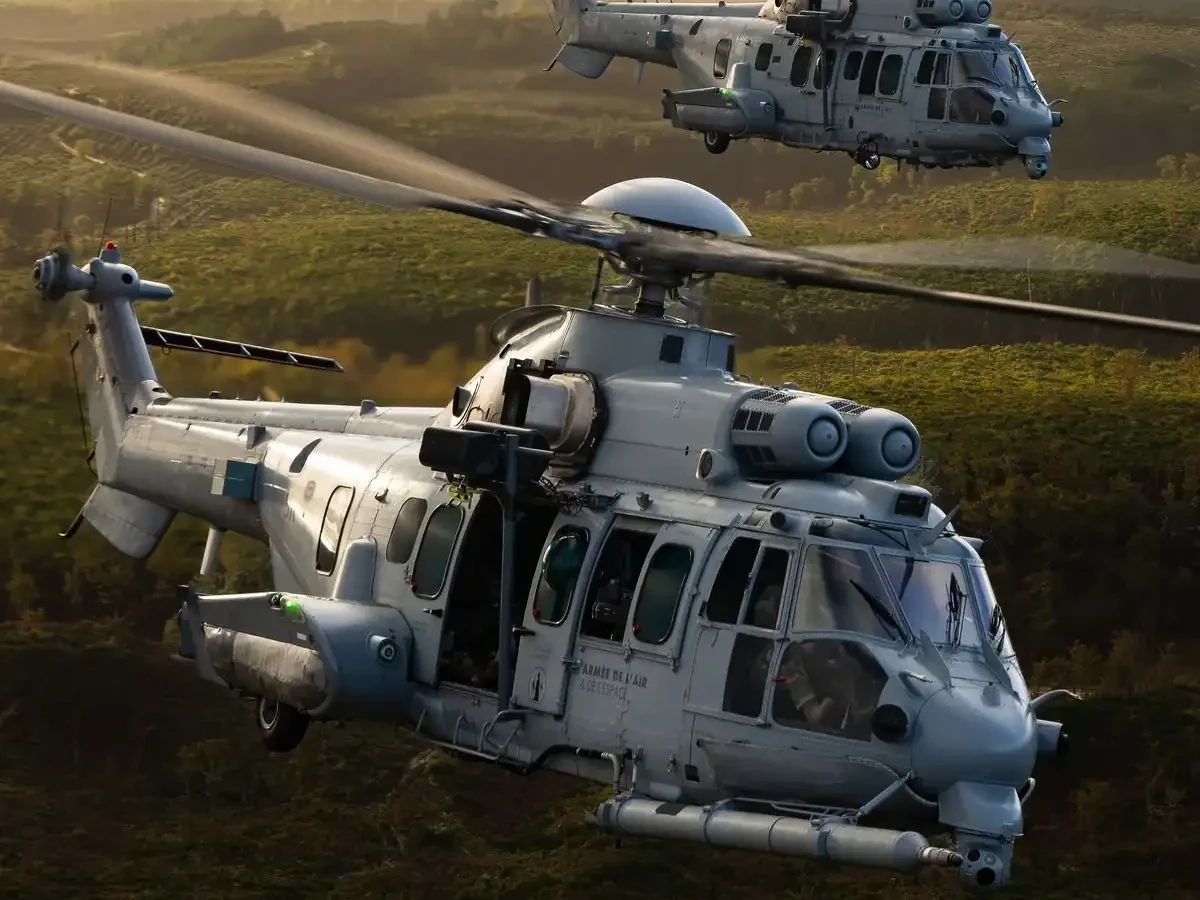
In 2024 the Royal Netherlands Air and Space Force (RNLASF) chose the H225M to support its special forces missions. Rotor finds out why the battle hardened platform was the right fit for the Dutch military and how the platform is evolving to keep its edge in future combat.
Choosing a new helicopter is not something that armed forces take lightly. Major William*, the Project System Integrator, notes that “helicopters have always been quite vulnerable machines, when flying low and slow, compared to jets... we’re in an environment which is more dangerous, and it’s getting more dangerous every day.” The RNLASF’s process of choosing a helicopter began by assessing which one would be best to support special operations forces (SOF). The RNLASF’s current fleet of Cougars have been in operation for around 30 years. Material and IT Command (COMMIT) Project Manager, Petrick, explained the complexity behind making the right choice for its replacement.
“There were more than 100 different criteria,” he explains. “We selected the H225M based on the fact that it’s proven for SOF, offers excellent range, cabin capacity and flexibility, interoperability, available mission equipment and compliance to Netherlands Military Aviation Regulations.” According to Major William, another factor that tipped the scales in the favour of the H225M was its ability to perform on land and at sea. “It will operate for both the land forces and the maritime forces. So we were looking for a helicopter which could do both. There are not a lot of medium utility helicopters which can do both.”
Proven for today, ready for tomorrow
The H225M is recognised as an international benchmark for Special Forces operations due to its unmatched combination of heavylift payload capacity, high survivability and extended combat radius,” explains Zorana Franovic, Airbus Helicopters’ Head of Contracts for the Super Puma. Yet, not only is the H225M already one of the best options on the market, but Franovic insists it is set to get even better. “The RNLASF configuration will be one of the most advanced tactical SOF variants ever produced in the Super Puma programme,” she explains. “It will feature improvements on cyber security protection, self-protection of the helicopter, communication systems and protection of ground troops and assets.”
Franovic believes that the Super Puma’s multi-functionality is what sets it apart. “Specialised, single mission military aircraft cannot perform the same variety of operations. The H225M is a versatile multi-mission asset that can be upgraded. It is a continuously evolving combat asset designed to give operators the best possible platform, even beyond 2040.” Franovic also points out that the H225M excels in hostile environments, thanks to its 360º electronic warfare self-protection suite, a 4-axis digital flight controls for degraded visual conditions, and versatile tactical extraction systems like fast-roping and special patrol insertion/extraction (SPIE).
She states that maintaining the platform’s multi-mission capacity while integrating new technology will be essential to it remaining the best option on the market. “Today, our challenge is to keep pace with technological advances, like teaming, while maintaining the versatility of a single airframe,” she says. As work begins on the first of the RNLASF’s H225Ms, turning these cutting-edge capabilities into operational reality ultimately comes down to joint execution. “It’s a challenging project with a lot of complexity,” concludes Petrick. “The cooperation between our team, the RNLASF, and the core team of Airbus — and the communication and transparency we have working together — that’s the key to success.”

Update Comment