

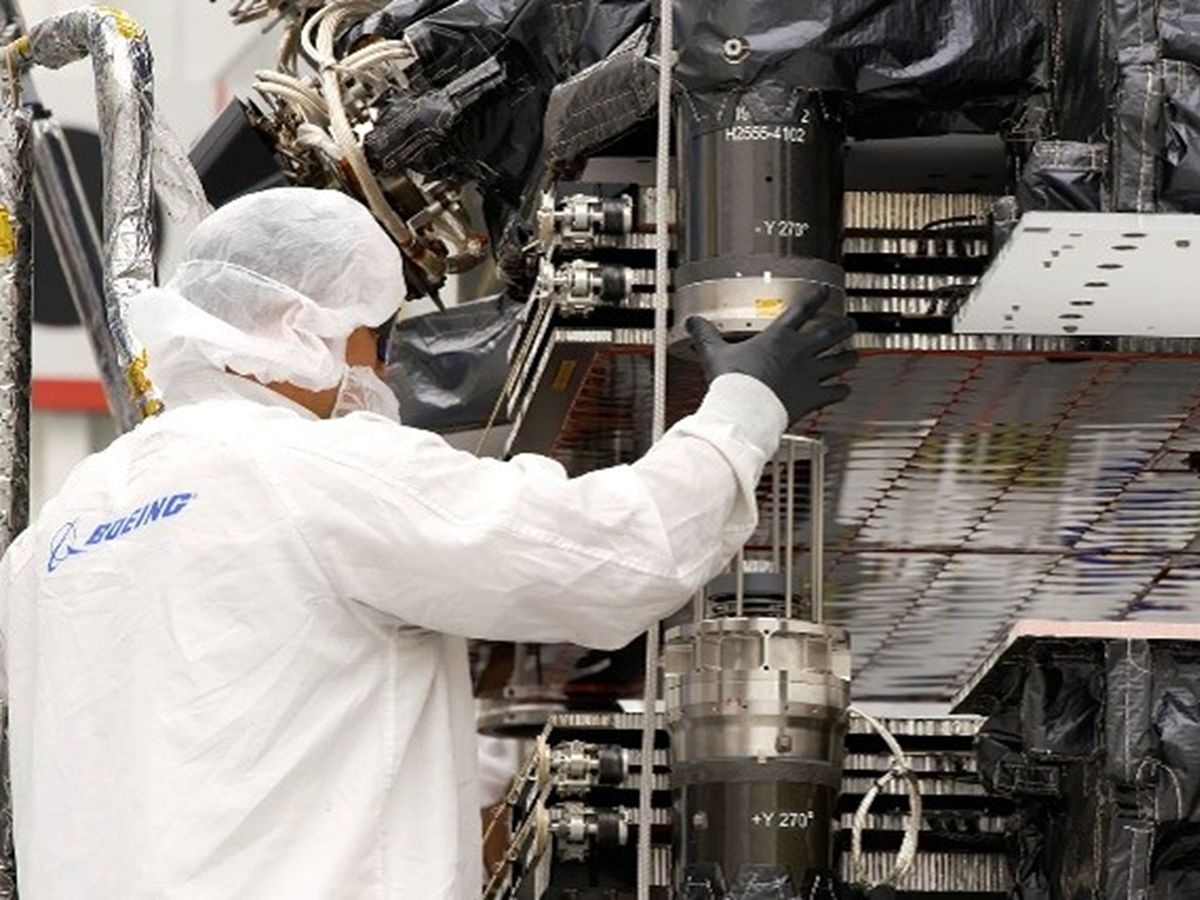
Boeing [NYSE: BA] announced delivery of the final three O3b mPOWER satellites – F11, F12 and F13 – to space solutions provider SES. The F11, F12 and F13 satellites will add incremental capacity to the initial O3b mPOWER constellation, strengthening SES’s medium Earth orbit (MEO) network with the ability to successfully deliver predictable low latency, exceptional throughput and uncontended bandwidth, setting the standard for global connectivity.
This delivery marks the successful conclusion of the program's initial 13-satellite constellation, a historic milestone for the long-term strategic partnership between the companies.
“The delivery of these final three satellites allows us to ramp up our constellation's capabilities to meet growing commercial and government demand,” said Xavier Bertran, chief product and innovation officer of SES. “The performance we are seeing from the 10 satellites already in orbit validates this architecture. The completion of the O3b mPOWER system reinforces our proven leadership in MEO while advancing our innovation roadmap.”
O3b mPOWER satellites enable people to access the internet where they otherwise couldn’t – including students in remote places being able to connect online for schoolwork and physicians in small villages being able to provide telehealth support.
Others utilising SES’s MEO network include government organisations, civil entities, mobile operators, commercial airlines and cruise lines.
In addition, the operational O3b mPOWER constellation in orbit serves as a technical baseline for critical national security systems. Boeing is using a hardened version of this proven software-defined payload architecture for military SATCOM (MILSATCOM) programs to design and build the U.S. Space Force’s Wideband Global SATCOM (WGS)-11 and WGS-12 systems, alongside Evolved Strategic SATCOM (ESS). With the 702X spacecraft platform flying the O3b mPOWER software-defined payload, Boeing has produced a standardised dual-use system optimised for quick-delivery, high-performance constellations in any orbit.
Boeing is leveraging space-proven, commercially matured hardware for defence programs. By transitioning these mature, commercial systems to national defence applications, Boeing offers its joint-force customers an established manufacturing line that aims to minimise schedule risk.
“The fully operational O3b mPOWER constellation proves the effectiveness of our software-defined payload technologies, shown by our ability to secure the most demanding missions of our commercial, joint-force and allied military customers,” said Ryan Reid, president of Boeing Satellite Systems International. “Our continued partnership with SES demonstrates our commitment to customer priorities and our ability to innovate technology and push the boundaries of what's possible in satellite communications.”
Boeing and SES will also help prepare for the satellites’ launch from the Florida Space Coast scheduled for September, with an expectation for them to enter service in mid-2027 following orbit raising and initialisation activities.



Update Comment